
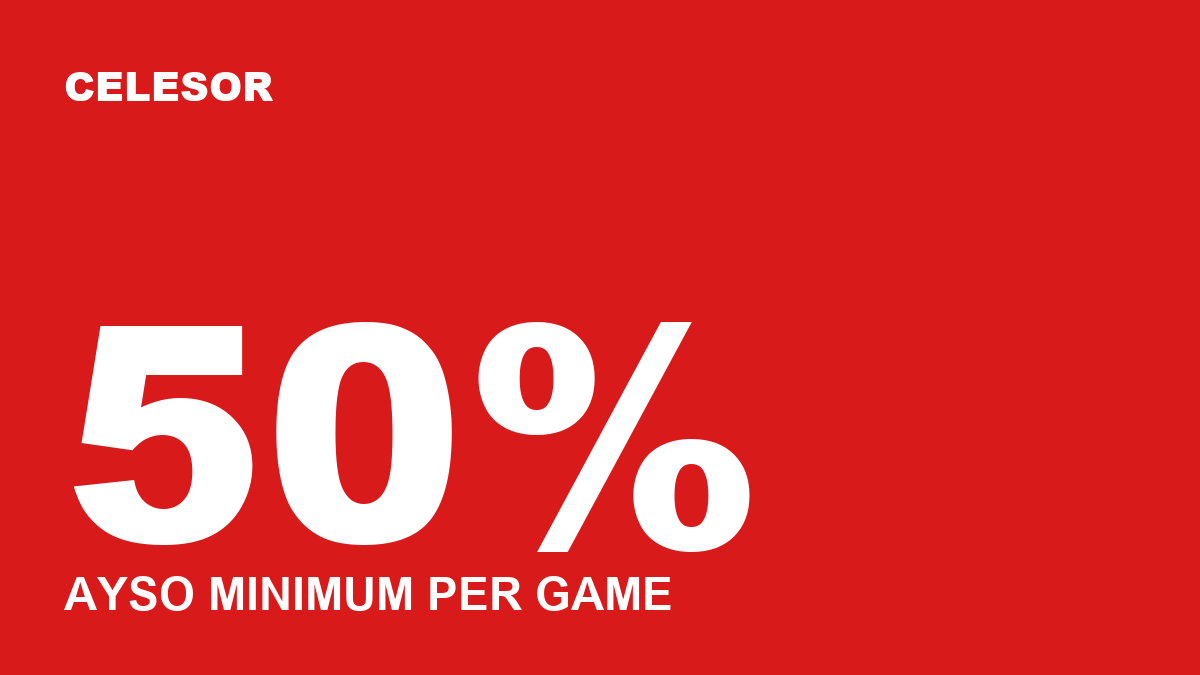
Quick answer: Multiply the game minutes by the players on the field, then divide by the number of players on your roster. That is each player's equal share. There is no single national rule, but AYSO requires every player to play at least half of every game, and U.S. Soccer's youth standards recommend the same minimum.
The formula
Equal playing time is simple division. Count the minutes the ball is in play for the whole game, multiply by the number of players your team has on the field at once, and divide by the number of players on your roster.
Each player's minutes = game minutes x players on the field / players on the roster
The goalkeeper counts as one of the players on the field. Add up every player's minutes and you get the same total as the top of the formula, so nothing is lost or counted twice.
Is there a rule?
There is no single national rule for how much a youth player must play. The rule comes from the league, and the sources we read set a floor, not an equal share.
- AYSO: its Everyone Plays philosophy says every player on every team must play at least 50 percent of every game. Its referee guideline says all eligible team members in attendance must play at least half of the game, excluding overtime.
- U.S. Soccer: its youth standards say that in 4v4 everyone should play at least 50 percent of the time, and that in 7v7 and 9v9 every player should play a minimum of 50 percent of the time in each game. These are recommendations, and the document is from 2017.
- US Youth Soccer: its policy defines a recreational league as one whose rules require each player to play at least one-half of each game, except for reasons of injury, illness or discipline.
If your league has its own rule, that rule wins. Half is the floor in all three. Equal is the goal you can aim for above it.
Worked example: 7v7
A U10 team plays two 25-minute halves, which is 50 minutes. Seven players are on the field, and the roster has 10 players.
- Game minutes: 2 x 25 = 50.
- Player minutes on the field: 50 x 7 = 350.
- Equal share: 350 / 10 = 35 minutes each.
- Check the floor: half of 50 is 25 minutes. 35 is above it.
Each player plays 70 percent of the game. Every player sits for 15 minutes.
What roster size does to the share
Each extra player on the roster lowers everyone's share. These figures use the formula above for a 50-minute 7v7 game.
| Roster | Minutes each | Share of the game |
|---|---|---|
| 8 | 43.8 | 88% |
| 9 | 38.9 | 78% |
| 10 | 35.0 | 70% |
| 11 | 31.8 | 64% |
| 12 | 29.2 | 58% |
The roster limit that still meets a 50 percent floor is always twice the number on the field. At 7v7 that is 14 players. League caps are lower: U.S. Soccer's standards say rosters should include no more than 12 players at 7v7, and AYSO's referee guideline lists a maximum of 10 team members.
Worked example: 9v9 and 4v4
9v9, roster of 12. The game is two 30-minute halves, or 60 minutes. 60 x 9 = 540 player minutes. 540 / 12 = 45 minutes each, or 75 percent. At the U.S. Soccer cap of 16 players the share falls to 33.75 minutes, or 56 percent, still above half.
4v4, roster of 6. U.S. Soccer's 4v4 standard is four quarters of up to 10 minutes, so 40 minutes. 40 x 4 = 160 player minutes. 160 / 6 = 26.7 minutes each, or 67 percent. The same standard says having 6 players on each team helps maximize participation and engagement.
Turning the math into a plan
- Find your league's game length and format. Our game length guide lists the numbers three governing bodies publish.
- Run the formula for your roster and write down the share, in minutes.
- Split the game into equal blocks that match when your league lets you substitute. AYSO's substitution points are about midway through each half and at half-time, so it works in four blocks.
- Decide before kickoff who sits in each block. Our rotation guide has patterns for 4v4, 7v7 and 9v9.
- Write down who sat. A notebook, a spreadsheet or an app all work, as long as you add up the minutes after each game.
When equal is not exact
Blocks rarely divide evenly. A roster of 10 at 7v7 has 12 sit-out slots across four blocks, so two players sit twice. Give the extra sit-out to different players each game and the totals even out over a season.
Late arrivals, injuries and overtime change the numbers too. AYSO's guideline sets a one-quarter minimum for a player who arrives during the second or third quarter, and its 50 percent rule excludes overtime. If your league has no such rule, decide yours before the season and tell parents.
Some AYSO Regions choose a stricter option, the three-quarter rule: no player plays an entire game unless all other players on the team will play at least three quarters of the game. AYSO says this option is frequently used in Regions throughout AYSO.
The bottom line
Game minutes x players on the field / players on the roster gives each player's equal share. Half of every game is the floor that AYSO requires and U.S. Soccer recommends. Read your own league's rule, run the numbers before the first game, and write down who sat.
Quick questions
Does every youth soccer player have to play half the game?
In AYSO, yes: every player on every team must play at least 50 percent of every game. U.S. Soccer's 4v4, 7v7 and 9v9 standards say every player should play at least 50 percent. Other leagues set their own rule, so read yours.
How many players can be on a roster?
U.S. Soccer's standards say no more than 12 players at 7v7 and no more than 16 at 9v9. AYSO caps team members at 10 for 7v7 and 12 for 9v9. Smaller rosters give each player more minutes.
What if a player arrives late?
Under AYSO's referee guideline, a player who arrives during the second or third quarter must play a minimum of one quarter. Your league may handle late arrivals differently.
What is the three-quarter rule?
It is an option AYSO says many of its Regions use: no player plays an entire game unless all other players on the team will play at least three quarters of the game.
Sources
- AYSO, Six Philosophies (Everyone Plays), read November 14, 2026. Page carries no date
- AYSO, Referee Guideline 2026-2027, read November 14, 2026
- AYSO, Standard Regional Policies and Protocols (March 2025), read November 14, 2026
- U.S. Soccer, Player Development Initiatives (February 2017), hosted by US Youth Soccer, read November 14, 2026. Dated 2017
- US Youth Soccer, Policy on Players and Playing Rules (June 23, 2026), read November 14, 2026
- Cal North, Player Development Initiatives (edited June 2026), read November 14, 2026. A state association's adaptation of the U.S. Soccer standards; repeats the same 50 percent line